The Assessment of the Factors Influencing Warehouse Performance in Manufacturing Companies: Evidence from Tanzania Breweries Limited
Abstract
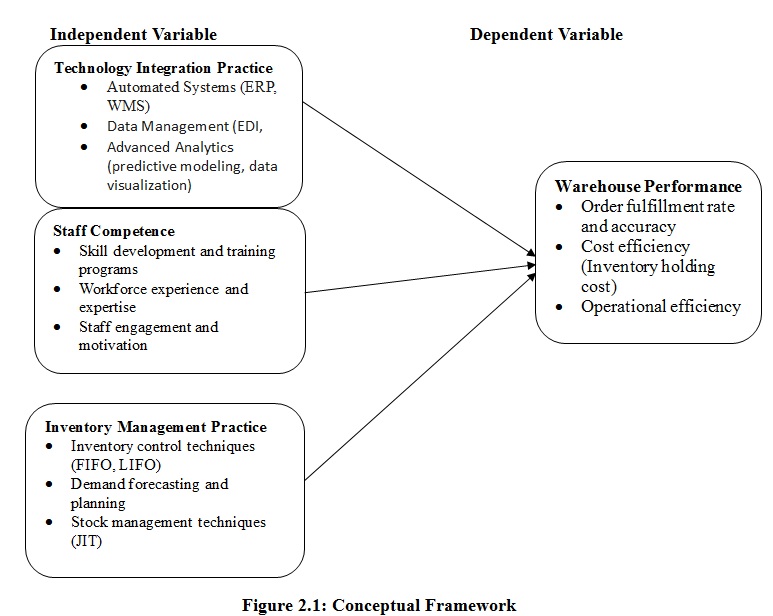
This study assessed the factors influencing warehouse performance in Tanzania's manufacturing industry, using Tanzania Breweries Limited (TBL) as a case study. Specifically, the study examined the influence of technological integration practices, staff competence, and inventory management practices on warehouse performance. The study was guided by the Resource-Based View (RBV) theory, which emphasizes the importance of organizational resources and capabilities in achieving improved performance. The study adopted a positivist research philosophy and a deductive approach, using a quantitative descriptive research design. Data were collected through structured questionnaires administered to employees involved in warehouse and logistics operations at TBL. A sample of 96 respondents was used. Data were analyzed using descriptive statistics, correlation analysis, and multiple regression analysis using IBM SPSS version 24. The research instrument was reliable, with Cronbach's Alpha coefficients ranging from 0.740 to 0.840. The findings reveal that technological integration practices have a significant positive relationship with warehouse performance (r = 0.482, p < 0.001) and make a significant positive contribution to performance (β = 0.349, p < 0.001). Staff competence demonstrates the strongest relationship with warehouse performance (r = 0.597, p < 0.001) and is the strongest predictor in the regression model (β = 0.520, p < 0.001). Inventory management practices also have a significant positive relationship with warehouse performance (r = 0.458, p < 0.001) and contribute significantly to warehouse performance (β = 0.422, p < 0.001). The overall regression model is statistically significant, F(3,92) = 62.808, p < 0.001, with R² = 0.672, indicating that the three factors jointly explain 67.2% of the variation in warehouse performance. The study concludes that technological integration, staff competence, and inventory management are important organizational resources and capabilities for improving warehouse performance at TBL. The findings support the Resource-Based View by showing that effectively combining and using technological, human, and inventory-related resources can enhance warehouse performance. The study recommends strengthening employee training and motivation, improving the integration and utilization of warehouse technologies, and enhancing inventory planning, stock rotation, forecasting, and control practices.
References
Ackerman, K. (2003). Warehouse Management: A Complete Guide to Improving Efficiency and Minimizing Costs in the Modern Warehouse. Kogan Page Publishers.
Alavi, A., & Ryding, B. (2020). Competency-based training in warehousing: Fostering a culture of improvement. Journal of Warehouse Management, 7(2), 45–62.
Barney, J. (1991). Firm resources and sustained competitive advantage. Journal of Management, 17(1), 99–120.
Bowersox, D. J., Closs, D. J., & Cooper, M. B. (2013). Supply Chain Logistics Management (4th ed.). McGraw-Hill.
Chen, F., & McGinnis, L. F. (2008). Performance Measurement in Supply Chain Management: A Review of the Methodologies. International Journal of Production Economics, 113(1), 151–171.
Chong, A., Lo, K., & Wong, S. (2019). Lean inventory management: Insights into lead time reductions. Supply Chain Management: An International Journal, 24(3), 304–316. - Huang, Y.,
Chopra, S., & Meindl, P. (2016). Supply Chain Management: Strategy, Planning, and Operation (6th ed.). Pearson.
Christopher, M. (2016). Logistics & Supply Chain Management (5th ed.). Pearson.
Collins, D. (2006). Metrics for Measuring Warehouse Performance. Journal of Business Logistics, 27(2), 79–102.
Coyle, J. J., Langley, C. J., Novak, T., & Gibson, B. (2016). Supply Chain Management: A Logistics Perspective. Cengage Learning.
DeHoratius, N., & Raman, A. (2008). Inventory record inaccuracy: An empirical analysis. Management Science, 54(4), 627–641.
Destro, I. R., Staudt, F. H., Somensi, K., & Taboada, C. (2023). The impacts of inventory record inaccuracy and cycle counting on distribution center performance. Production, 33, e20220077.
Dyer, J. H., & Singh, H. (1998). The relational view: Cooperative strategy and sources of interorganizational competitive advantage. The Academy of Management Review, 23(4), 660–679.
Elsayed, K., & Wahba, H. (2016). Reexamining the relationship between inventory management and firm performance: An organizational life cycle perspective. Future Business Journal, 2(1), 65–80.
Eroglu, C., & Hofer, C. (2011). Lean, leaner, too lean? The inventory-performance link revisited. Journal of Operations Management, 29(4), 356–369.
Cook, R. L. (2015). Supply Chain Management: The Pursuit of a Collaborative Advantage. Business Horizons, 58(4), 431–440.
Global Health Supply Chain Program. (2021). Performance improvement for warehousing and distribution. GHSC-PSM. https://www.ghsupplychain.org/news/performance-improvement-warehousing-and-distribution (ghsupplychain.org)
Goh, M., & Lai, K. H. (2016). Evaluating the Effect of Management Practices on Warehouse Performance: A Review. International Journal of Production Research, 54 (21), 6288–6302.
Guan, L., & Huo, B. (2014). The impact of supply chain integration on operational performance: The mediating role of operational capability. International Journal of Production Economics, 145(2), 543–555.
Harrison, A., & van Hoek, R. (2011). Logistics Management and Strategy: Competing Through the Supply Chain (3rd ed.). Pearson.
Ilies, D. C. (2009). The Link Between Logistics Performance and Business Performance: Evidence from the Romanian Market. Journal of Business Research, 62(11), 1122-1128. https://doi.org/10.1016/j.jbusres.2008.I07.002
Ilies, L., Turde, A., & Crisan, C. (2009). Warehouse Performance Measurement: A Case Study. Logistics & Transport, 12(3), 1-9.
Jiang, Y., & Zhang, J. (2020). Cross-training and its impact on operational flexibility in warehouses. International Journal of Logistics Management, 31(4), 851–865.
Johnson, J. C., & McGinnis, M. A. (2008). The importance of performance measurement in logistics.
Khan, A., et al. (2022). Enhancing operations management through smart sensors: Measuring and improving well-being, interaction and performance of logistics workers. arXiv. https://arxiv.org/abs/2112.08213 (arxiv.org)
Kisinga, D. C., Mchopa, A. D., & Mwagike, L. R. (2024). Warehouse management practices and business performance of small-scale grapes processing firms: Evidence from Tanzania. Cogent Business & Management (Taylor & Francis). https://www.tandfonline.com/doi/full/10.1080/23311975.2024.2427215 (tandfonline.com)
Kumar, A., & Singh, R. (2020). Automation in warehousing: Enhancing productivity and reducing labor costs. International Journal of Operations & Production Management, 40(7/8), 1249–1265.
Kumar, S., & Singh, R. (2017). Warehouse Efficiency: An Analysis of Influencing Factors. International Journal of Supply Chain Management, 6(1), 50–61.
Lee, Y. H. (2021). The role of effective inventory management in warehousing operations. Journal of Business Research, 123, 242–253.
Mascolo, G. (2015). Enhancing warehouse performance in developing countries: A focus on Tanzania. African Journal of Business Management, 9(6), 250–260.
Neely, A. (1995). The Variance of a Measure: A Framework for Performance Measurement. International Journal of Operations & Production Management, 15 (2), 46–64.
Nguyen, T., Lee, S., & Tan, K. (2022). An analysis of inventory forecasting methods and their influence on operational performance. International Journal of Production Economics, 234, 32–45.
Richard, C. (2014). Assessing the growth of the brewing industry in Tanzania: Challenges and perspectives. Journal of Business and Management, 16(2), 90–97.
Bowersox, D. J., Closs, D. J., & Cooper, M. B. (2013). Supply Chain Logistics Management (4th ed.). McGraw-Hill.
Richard, C. (2014). Assessing the growth of the brewing industry in Tanzania: Challenges and perspectives. Journal of Business and Management, 16(2), 90–97.
Rodriguez, A., & Altmann, J. (2021). Competency-based training in warehousing: Fostering a culture of improvement. Journal of Warehouse Management, 7(2), 45–62. - Stone, R. F., Kumar,
Sabry, K. (2015). Measuring the performance of warehouses in supply chains.
Tam, W. Y., Hsu, C. C., Chan, R. K., & Tang, F. (2016). The impact of human resource management practices on service quality: The moderating role of technology. Journal of Services Marketing, 30(6), 657–670.
Tompkins, J. A., Smith, J. D., & Smith, K. L. (2003). The Warehouse Management Handbook. Tompkins Press.
Wang, Y., Gunasekaran, A., & Ngai, E. W. T. (2016). Big Data in Supply Chain Management: A Review of the Literature and Future Research Directions. Transportation Research Part E: Logistics and Transportation Review, 99, 222-236.
Wang, Y., Gunasekaran, A., & Ngai, E. W. T. (2016). Supply chain management and logistics performance in manufacturing industries: Trends, opportunities, and challenges.
Winkelhaus, S., & Grosse, E. H. (2022). Smart warehouses—a sociotechnical perspective. In The Digital Supply Chain (book chapter; publisher record). https://www.sciencedirect.com/science/article/abs/pii/B9780323916141000034 (sciencedirect.com)
Wong, C. Y., Boon-itt, S., & Wong, C. K. (2017). The Roles of Logistics and Supply Chain Operations in the Success of E-commerce. International Journal of Physical Distribution & Logistics Management, 47(8), 742–763.
Yousefi, N., & Alibabaei, A. (2015). Technology integration in warehouse management: A study of ERP systems.
Yu, M. (2008). Enhancing warehouse performance by efficient order picking [Doctoral dissertation, Erasmus University Rotterdam]. Erasmus University Repository.
Zheng, Z., Li, D., & Yang, X. (2021). The role of Internet of Things in smart warehouses: